I left Ghana more than a year ago and I've back to this blog a few times to revisit my thoughts and experiences. Most of these times, I had the feeling that a lot of what EWB would call "the learning" did not get completely captured in this blog. However, I think that I am in a better position to evaluate this learning now that I've allowed the experience to totally sink in.
I must confess that I struggled a bit when I got back. Mostly, I had a hard time coming to terms with the summer, in particular how different my experiences were in comparison with what I had expected and what other volunteers experienced. All the traveling and adjusting finally took a toll on me, especially on my last days in Accra - I was ready to be done. When I returned to Canada, I felt this tremendous responsibility of communicating everything back to the chapter and felt (still feel) a bit unsatisfied with the role I took with the chapter when coming back. But the hardest part was probably going home to Guatemala and having to face some really tough questions from my own family, such as: "Do you think you had any impact?". I would like to think that I did. Here is why:
At the beginning of the summer, KITE’s knowledge of what the situation was at the RBCs was limited to the data that had been collected by the eCARE office, managed by a different project partner.This was mainly information on loan repayment of the centres and technical challenges that had been reported.The information was not always available to KITE - yes, communication between the project partners was more than terrible.KITE itself had a vague idea as to what the situation was like for the entrepreneurs and little was known of what was keeping them from being profitable. This situation was a result of internal challenges in KITE such as lack of people resources to go to the field, lack of incentives for their coworkers to produce good work, being tied to other organizations for funding, and having a strong bias towards producing quantity and not quality (a consequence of donors having similar expectations).
I can say now that the biggest change that occurred through my involvement was with regards to KITE’s knowledge and understanding of the project.After the placement, KITE had data from a combined total of 26 centres.Our analysis included subjective observations and recommendations based on our interactions with the entrepreneurs. So they had hypotheses and numbers to back them up.
Was this enough? Probably not. Did I influence the thinking at the project level? Yes. This new understanding of the project may have contributed to an increased “momentum” in the meetings with other project partners that happened close to the end of the summer.Both the director and eCARE project officer were working towards and pushing for results to solve some of the existing problems before the deployment of any new centres.Having information available made it easier for KITE to push for results from other project partners too.
I accept the fact that the sustainability of my activities was limited because of the few interactions I was able to have with KITE staff.Ideally, I would have liked to work more closely with the project manager in the monitoring process.My impact might have been doubled if the eCARE person at KITE would have gone through the same learning cure as I did!
One of my biggest challenges was to understand the connection between my actions and the ultimate beneficiary because I only had limited interactions with the customers of the centres.Somewhere in the middle of my placement, I realized that I could think of Dorothy as the end user of the centres or the entrepreneurs themselves. I decided to focus on what my results could be for the entrepreneurs because I was working more closely with them. Many EWB volunteers would agree, I think, that their impact was mostly on their coworkers or other development "champions", not necessarily Dorothy. This was a tough realization, but it also allowed me to be more focused on existing and future entrepreneurs and their ability to provide better and more suitable ICT services to their communities.
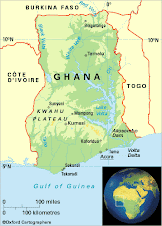
However, my biggest challenge while overseas was by far being always on the move.Although I got to know Accra the best, I had host communities in 5 different regions in Ghana(and slept in a total of 30 different beds!).I never spent more than a couple of days at one place before I was required to move again. So not only was I in a different country, I spent so little time at each location that often I felt like I had no "home" to come back to.A lot of my energy and time were spent traveling, gaining trust, and adapting to new surroundings.Sometimes I felt that I was perceived as just another visitor and reinforcing this perception of Westerns through my short visits made me very uncomfortable. However, now I can see more clearly that I gained a lot from this. I learned about about myself and how I deal with new situations, also about active listening and being able to make connections with people over a short period of time.I learned to be open, adaptable, flexible and more comfortable with ambiguity.
Traveling allowed me to gain a perspective of what Ghana is as a whole.I was able to see the huge differences that exist between Northern and Southern Ghana, and urban and rural communities.When I think of Ghana now, I don't think only of a remote community ,I think of the challenges that different geography, conflicting religious practices, several languages and modern and traditional cultural practices put on Ghana's development as a whole.
During my travels and village stay it became apparent that many Ghanaians still lack access to basic rights: food security, access to clean water and sanitation, health care, and education.The government does not have the capacity, resources, or systems in place to provide these services to all areas successfully and equally.The lack of infrastructure makes it hard for services to reach those who really need it and for people to reach markets and services.Economic activity is limited by the lack of capital available to process goods and add value to products in Ghana before they are exported.Local products cannot always compete with subsidized products from other countries.
At the local level there are few or no incentives for people to excel in their work.People in hospitals, schools, community organizations, and government bodies are not paid enough to make a living and need to take on other activities to supplement their income.Many are not attracted to work in rural areas.Even when education is available, Ghanaians are not always able to make a living with the skills they have, let alone build on these skills.Local entrepreneurs have little support in starting businesses and providing services those services the government is not able to provide.Because of this lack of opportunities, some decide to leave, taking with them skills and knowledge that could contribute to the development of their communities. Often, they move to already densely populated urban centres like Accra where the safety networks are smaller and the opportunities for jobs and amenities are restricted to those with education, connections, and money. There are a few who don't, the eCARE entrepreneurs I met being an example. These are individuals who drive development in the most remote areas.
My idea of development being complex was reinforced by going to Ghana. Now, my concept of development is more than the ability to fulfill the basic human rights that I mentioned,above ,it includes the ability to make choices about those rights. I understand better the importance of taking rigorous approaches in development, and building organizations that can implement projects with a thoughtful and critical approach. I experienced first hand that volunteers can and do play a role in supporting excisting organizations by providing energy , enthusiasm, and a fresh perspective.They can challenge these organizations by connecting them to the people they are trying to help and asking the really tough questions. But to do this, it takes effort and hard work.
This post is already too long. So I'll conclude by saying that the adventure is not over. I'll continue to reflect about Ghana and find ways to share what I learned.