
e-CARE centers are extremely easy to spot
One of the questions I’ve been trying to answer (in a very informal way and mostly to myself of course) is what kind of benefits is the technology of these RBC’s having on people? Because I’m spending a couple of days at the centers I’ve been able to observe the kind of services clients are looking for and what the entrepreneurs are looking to provide in the future. Cell phones are BIG in

Matilda helping a client to get phone units for his cell phone
The center in Assin Praso is owned by Mr. Francis Mensah who employs two young ladies to work on the photocopying and typing. When he first got started he was having a hard time convincing the local government that they should give him the land to put the container on because, as he told me, they didn’t see the benefits that it could bring to the community. So because he is a builder by trade and he didn’t want this to stop him from starting his business, he made a concrete slab for the container at night when no one was looking! (I don’t know if I can believe this story but if it is true then he’s my new favorite civil engineer!) His center has the only photocopier and computer in town so the typing services are being used by many people including the primary and secondary schools and the water and sanitation development board community.

Mr. Mensah outside of his e-CARE container
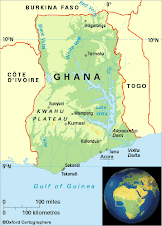
The last center that I went to is in Donkokrom, the district capital of the Afram Plains across the
 Nana Ofori and me
So what else am I doing apart from going on tro-tros and filling out surveys? Part of KITE’s vision for our placement was to provide some sort of support to the centers themselves. Although I would love to repair solar panels or give an intense workshop on finances and bookkeeping, I’m definitely not knowledgeable enough to do that! Instead, I’ve been holding short computer learning sessions with the entrepreneurs and employees on skills that could be useful for them such as typing, making posters and obituaries, using the computer to do their bookkeeping, and also discussing their ideas for the future including expanding or providing different services. I realize that this is highly unsustainable but at least it gives me an idea of the kind of support that entrepreneurs could benefit from.
However, my most important role is to communicate what I see to KITE and explore solutions with the rest of the team that can be used to change the way things work at the project decision level. There are definitely some obstacles keeping the entrepreneurs from doing more and being more successful with repaying the loan. For example, the use of the solar panels needs to be reviewed because the equipment cannot run on the battery alone for extensive periods of time and most entrepreneurs are still paying electricity bills because the batteries and the wiring are not appropriate for the solar system to work properly. Also, the entrepreneurs could benefit from closer contact with the e-CARE project in terms of support needed or maintenance concerns because right now there are few interactions between the project managers and the entrepreneurs except when technical concerns arise. Doing some research into the renewable energy products that are available in the market could also help to encourage entrepreneurs to sell them at their centers. The list is pretty long! Our challenge right now though is how do we do more than submit a report of things that need to change or recommendations that may or may be not implemented? The biggest challenge is the physical distance from the office. Shyam and I are trying to figure out how to engage the e-CARE staff on discussions of the processes of looking for a solution to some of these challenge. How do we make the most productive use of our time and still gather the data from the centers? What kind of tools can we work on with KITE to ensure that the project implementation is more effective? What kinds of recommendations are actually reasonable and easy to implement?


No comments:
Post a Comment